How to price service jobs for profit: labor burden, overhead and margin explained
Short answer: To price a service job for profit, add the true hourly labor cost (wages plus payroll burden), the overhead cost per billable hour and materials with handling markup, then divide by (1 minus your target margin). A technician paid $28/hour typically costs $38–42/hour with burden and $75–95/hour with overhead, which is why $60/hour pricing loses money.
Step 1: true labor cost
Start with the hourly wage and add payroll taxes, workers' compensation, benefits, paid time off and training time. For most small trades and clinics this burden adds 30–50% to the wage. A $28/hour technician costs roughly $38–42/hour before overhead.
Step 2: overhead per billable hour
Total your monthly fixed costs (rent, vehicles, insurance, software, phone, marketing, admin wages, owner salary) and divide by the number of billable hours you actually invoice in a month, not the hours worked. Drive time, quoting and callbacks are not billable. Most small service companies bill 50–65% of paid hours, which pushes overhead per billable hour to $35–55.
Step 3: materials and margin
Mark up materials to cover procurement, stocking, warranty and returns; 25–50% is common. Then set a target net margin (15–25% for most service businesses) and divide total cost by (1 minus margin) to get the price. A job with $250 labor cost, $150 overhead and $200 materials (cost $600) at a 20% margin should be priced at $750.
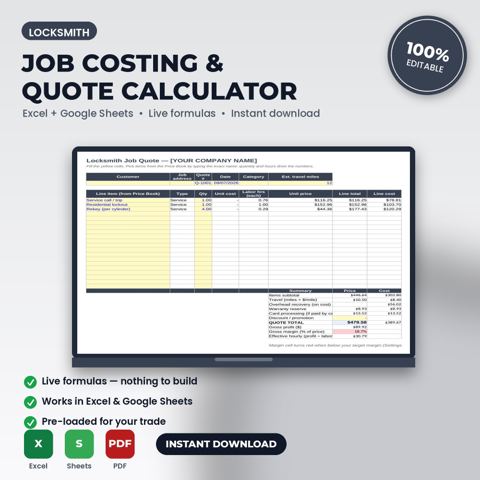
A job-costing spreadsheet does this arithmetic automatically and warns you when a quote falls below target. Log actual results after each job and adjust.
Frequently asked questions
Should I use hourly or flat-rate pricing?
Flat-rate pricing built from the cost method above is usually better for residential service: customers get a number up front and you are paid for efficiency. Hourly suits open-ended diagnostic or commercial work.
What margin should a small service business target?
Net margins of 15–25% are typical for well-run trades and clinics. Below 10% usually means overhead is not being recovered.