Who these dental office templates are for
Dentist-owners, office managers and treatment coordinators at independent general and specialty practices (1–3 dentists) who handle their own forms rather than buying an enterprise system. One location, 3–15 staff, paper or hybrid paper/digital intake, HIPAA compliance handled in-house.
The problems they solve
- New patient forms are outdated, inconsistent or missing required consent language.
- No-shows and late cancellations cost hours of chair time every week.
- HIPAA acknowledgment and staff confidentiality paperwork exists in theory but not in the file.
- Front desk procedures live in one long-time employee's head.
- Treatment consent for specific procedures is verbal, which means it is not defensible.
What a well-run dental office business wants from its paperwork
- Have a complete, professional new-patient packet ready to print or send.
- Reduce no-shows with a signed cancellation policy and scripted reminder messages.
- Document HIPAA and confidentiality compliance for every patient and employee.
- Standardize opening, closing and front-desk tasks so any team member can cover.
- Collect reviews and feedback systematically.
The complete guide to dental office business paperwork
The basics: the new-patient packet and why it matters
Every dental practice needs a new-patient packet: registration and health history, HIPAA notice acknowledgment, financial policy and general consent, and a cancellation and no-show policy. These four documents, signed at the first visit, set the legal and financial foundation for the entire patient relationship. Most disputes about billing, missed appointments and privacy trace back to a missing or badly written packet document.
Around the packet sit the operational documents: procedure-specific informed consent, appointment confirmation and reminder message scripts, a front desk SOP, opening and closing checklists, a supply inventory, an incident report and an employee confidentiality agreement.
Editable templates let a practice build a complete, consistent packet in an afternoon, using its own logo and policies, at a fraction of the cost of practice-management add-ons.
Intermediate: consent, financial policy and no-show control
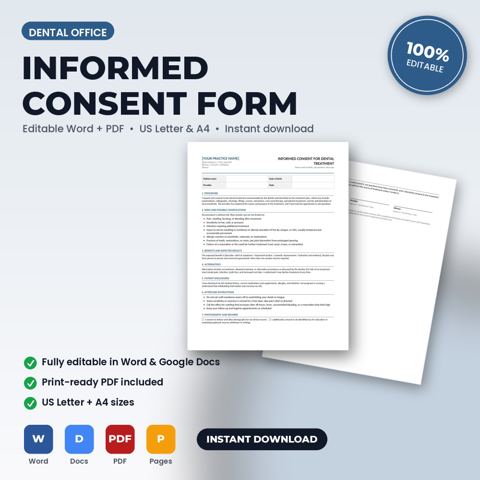
Informed consent must be specific to the procedure: risks, benefits, alternatives, the option of no treatment, and the patient's questions answered. A treatment-specific consent form with room for the clinician's notes protects the practice far better than a general consent line on the registration form.
The financial policy should state payment expectations, insurance responsibilities (estimates are not guarantees), payment plans and fees for returned payments and collections. Patients who signed a clear financial policy pay balances faster and dispute them less.
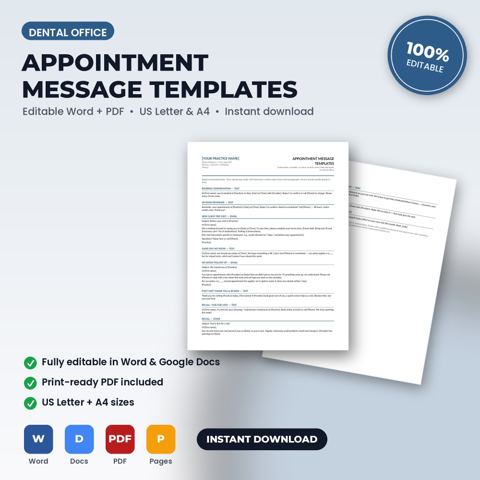
No-shows are a policy problem before they are a scheduling problem. A signed cancellation policy with a defined notice period and fee, reinforced by scripted confirmation and reminder messages at 48 and 24 hours, typically cuts no-shows substantially within a quarter. The script matters: a friendly, specific message with an easy reschedule option outperforms a generic reminder.
Expert: HIPAA, staff systems and the feedback loop
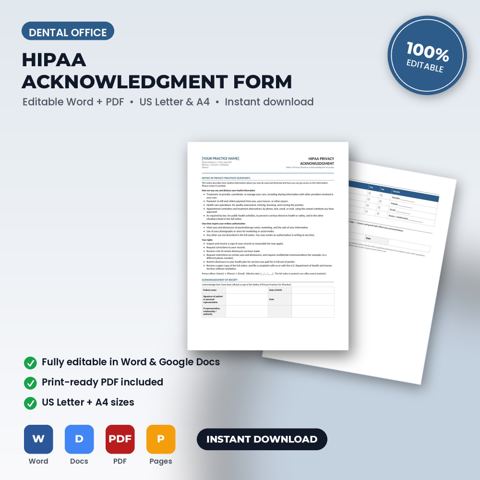
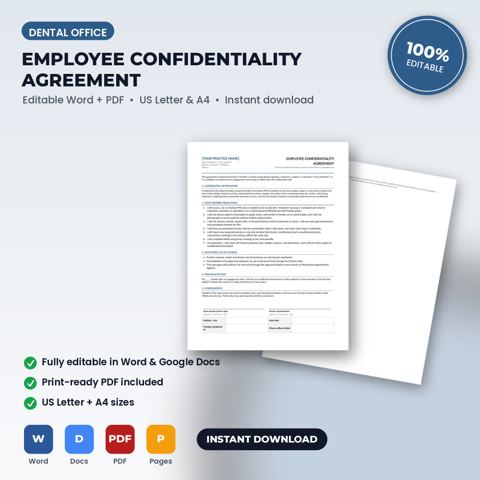
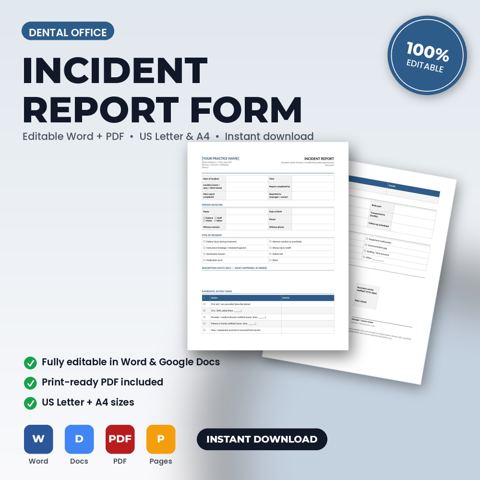
HIPAA compliance for a small practice is largely documentation: a Notice of Privacy Practices, a signed acknowledgment from each patient, workforce confidentiality agreements, and incident reports for any suspected breach or safety event. Templates for the acknowledgment, the confidentiality agreement and the incident report close the most common gaps found in audits.
Front-desk consistency comes from a written SOP: phone scripts, scheduling rules, insurance verification steps, check-in and check-out sequences and end-of-day reconciliation. Combined with opening and closing checklists (equipment, sterilization logs, cash handling, security), the SOP lets a practice train a new hire in days and survive a key employee's vacation.
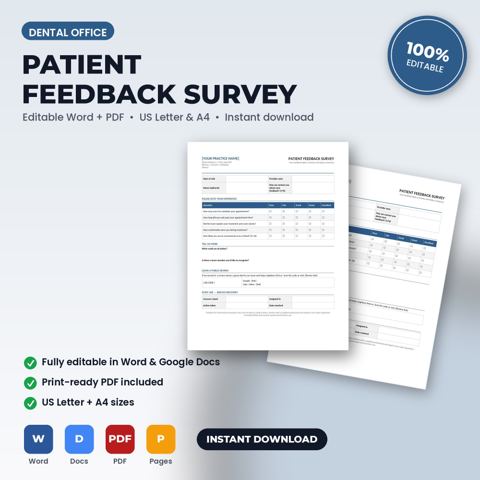
Finally, treat feedback as a system. A short survey handed out or sent after the visit, followed by a review request for satisfied patients, produces a steady flow of online reviews, which is the single biggest driver of new-patient calls for an independent practice.
Every dental office template, explained
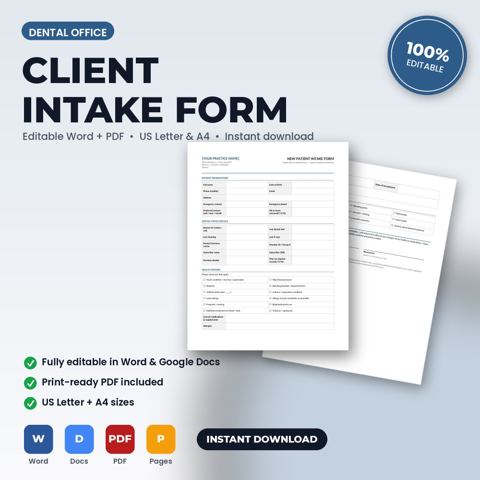
- Dental Office New Patient / Client Intake & Health History Form — Intake form, $7.99
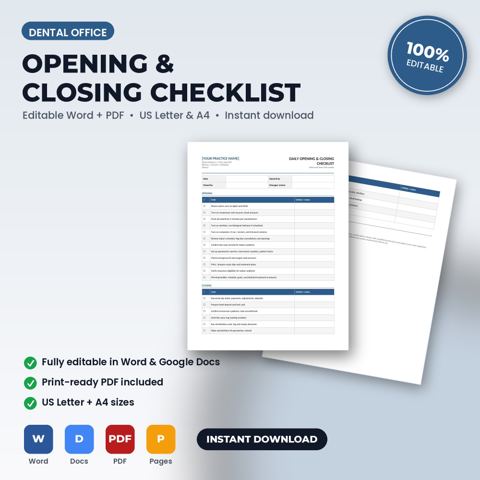
- Dental Office Daily Opening & Closing Checklist — Opening & closing checklist, $7.99
- Dental Office Appointment Confirmation, Reminder, No-Show & Recall Message Templates — Appointment message templates, $8.99
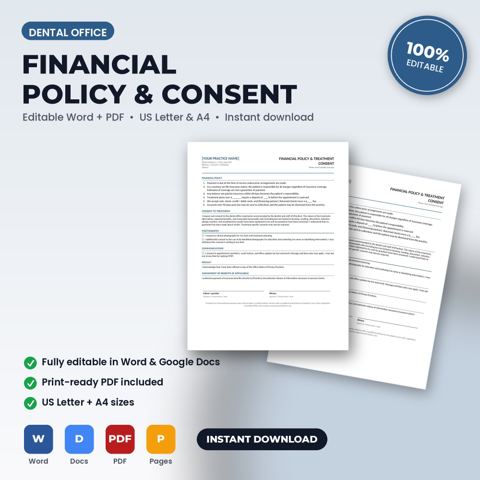
- Dental Office Financial Policy, Treatment Consent & Photo Release — Financial policy & consent, $9.99
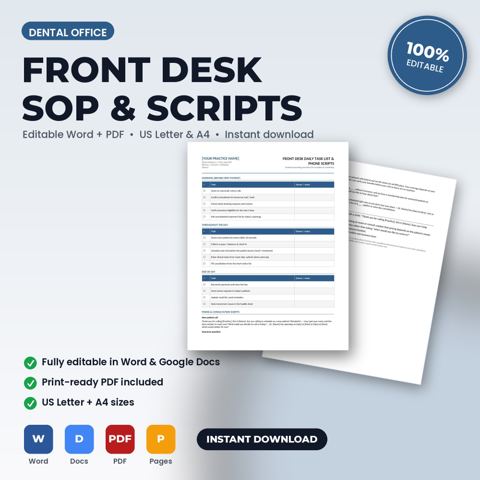
- Dental Office Front Desk SOP, Daily Task List & Phone Scripts — Front desk SOP & scripts, $8.99
- Dental Office Feedback Survey & Review Request Form — Feedback survey & review request, $7.99
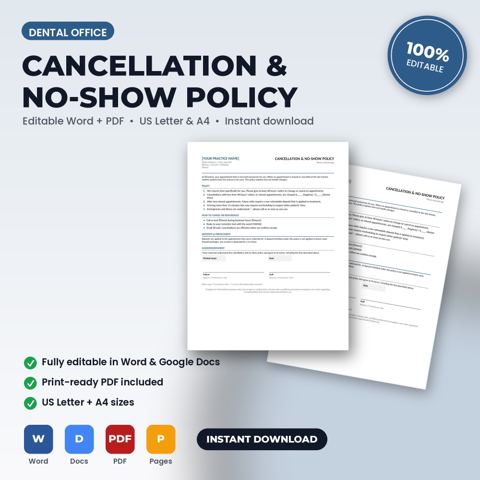
- Dental Office Cancellation & No-Show Policy — Cancellation & no-show policy, $9.99
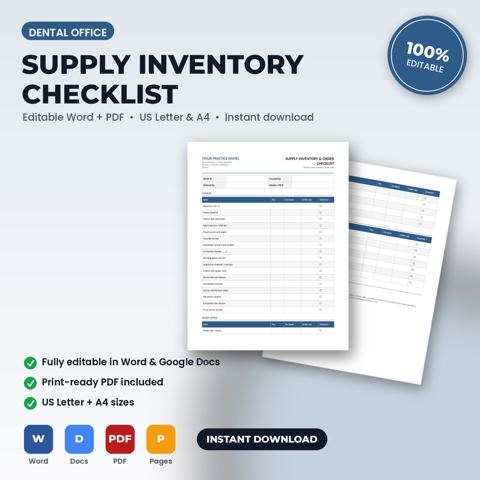
- Dental Office Supply Inventory & Order Checklist — Supply inventory, $7.99
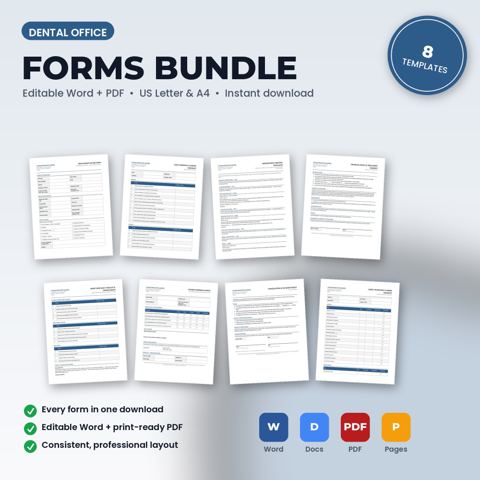
- Dental Office Forms Bundle — Forms bundle, $34.99
- Dental Office HIPAA Notice of Privacy Practices Acknowledgment & Communication Consent — HIPAA acknowledgment, $9.99
- Dental Office Employee Confidentiality & HIPAA Agreement — Employee confidentiality agreement, $12.99
- Dental Office Incident & Adverse Event Report Form — Incident & adverse event report, $9.99
- Dental Office Treatment-Specific Informed Consent Form — Treatment-specific informed consent, $14.99
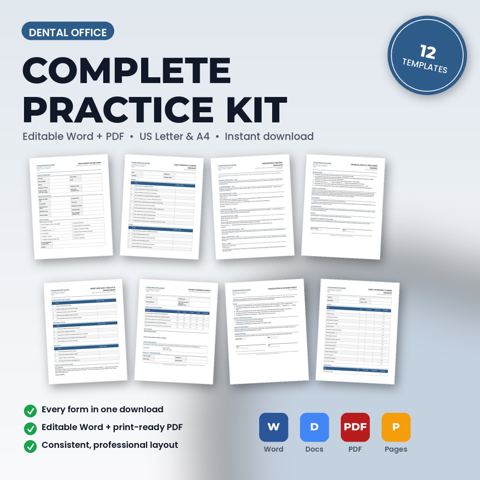
- Dental Office Complete Practice Kit — Complete kit, $69.99