What this bookkeeping & p&l tracker does for HVAC contractors
An Excel / Google Sheets tool built for HVAC contractors and heating & cooling technicians.
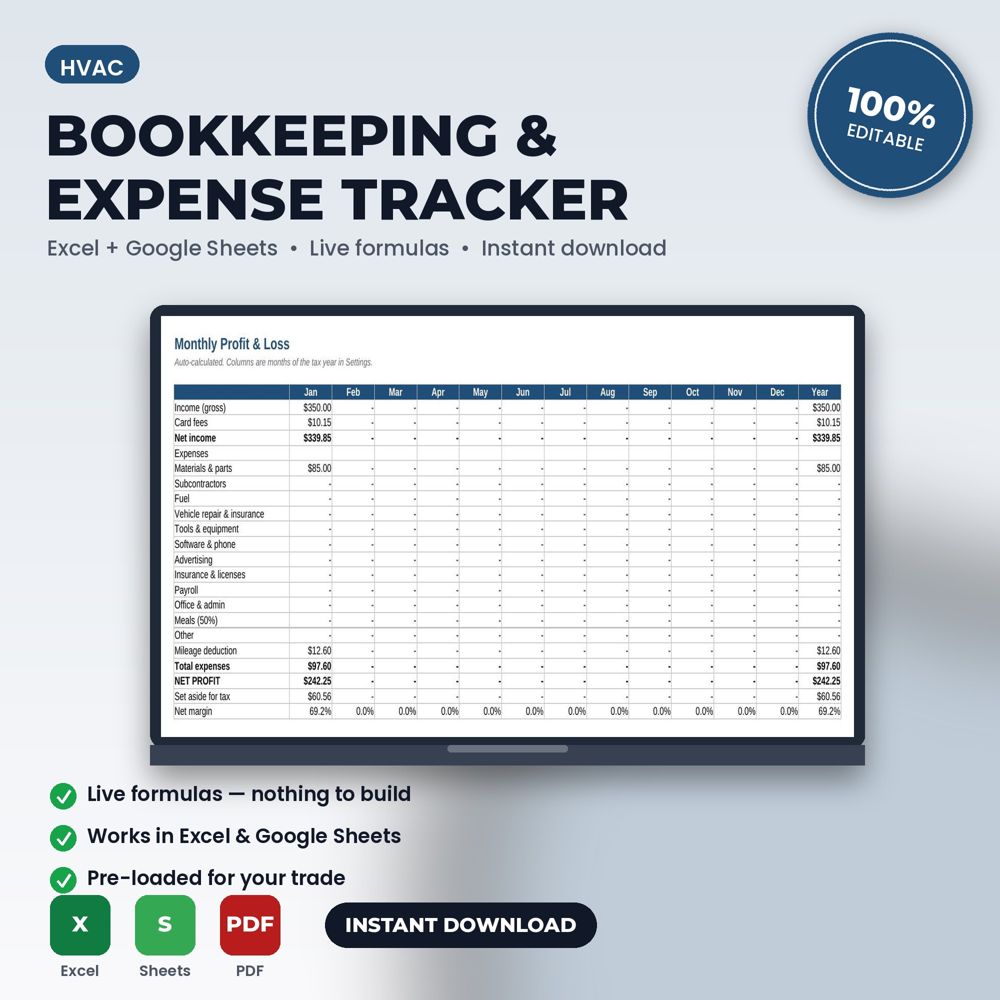
This spreadsheet keeps a small service business tax-ready: log income with card fees and net received, log expenses by an editable category list, track mileage with the automatic standard deduction, and get a monthly profit & loss plus a year-end tax summary tab your accountant can use directly.
Small service businesses fail on cash, not on work. A bookkeeping workbook designed for HVAC contractors makes it easy to record every invoice, expense and mile as it happens, and then shows monthly profit without any formulas to write. At tax time, the summary tab is what your accountant needs.
It also reveals patterns: which months are thin, which expense categories creep, how much of revenue is plan income versus one-time work.
What is inside the template
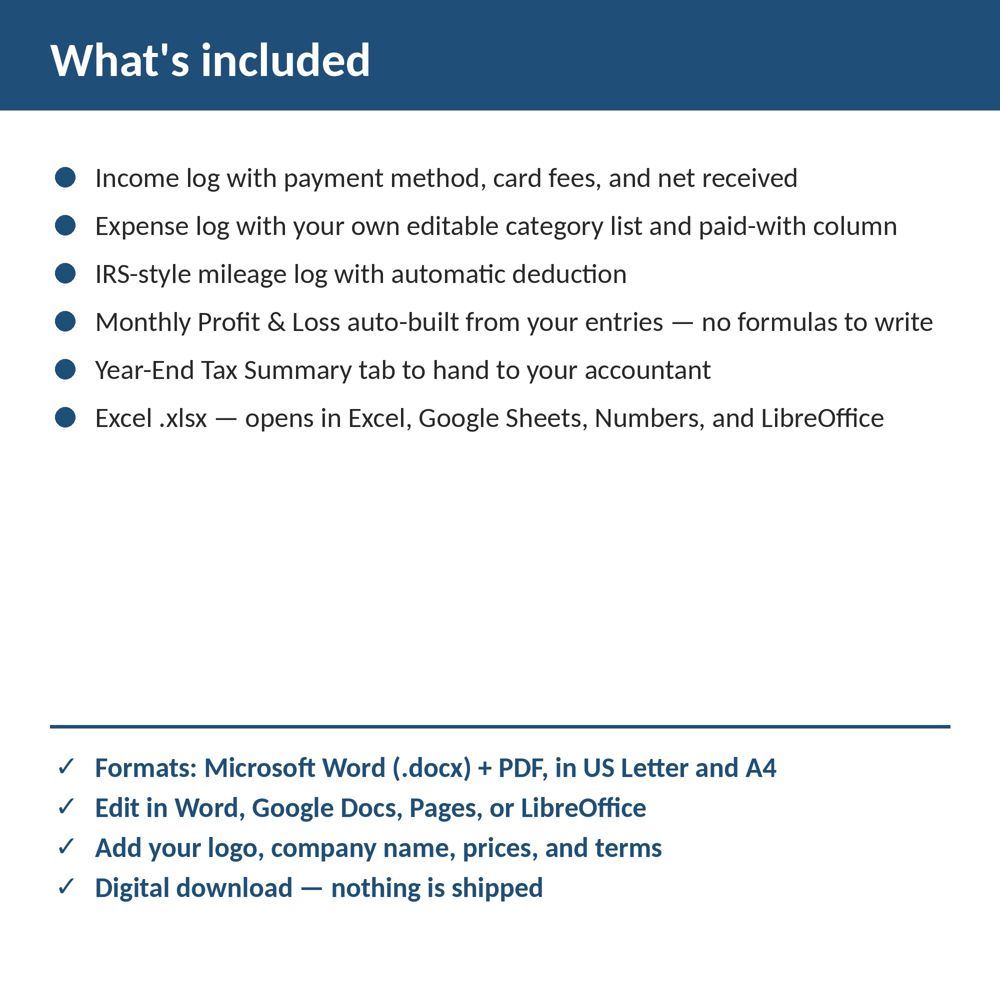
- Income log with payment method, card fees and net received
- Expense log with an editable category list and paid-with column
- IRS-style mileage log with automatic deduction calculation
- Monthly P&L built automatically from entries
- Year-End Tax Summary tab for your accountant
- No macros; works in Excel, Google Sheets, Numbers and LibreOffice
How to use it (step by step)
- Edit the category list to match your chart of accounts.
- Enter income when you invoice or when you are paid (pick one method and keep it).
- Log expenses weekly from receipts and bank statements; log mileage daily.
- Review the P&L on the first of every month; send the tax summary to your accountant at year end.
Common mistakes this template helps you avoid
- Recording income only when paid and expenses only when remembered, which produces a P&L that means nothing.
- Skipping mileage; for mobile businesses it is often the largest deduction.
- Mixing personal and business expenses in the log.
Expert tips from the field
- Add a 'plan revenue' category so recurring income is visible separately.
- Reconcile the income log against bank deposits monthly; discrepancies are usually unpaid invoices.
- Keep the workbook in cloud storage so the office and owner see the same file.
Why HVAC contractors choose this over a generic template
Generic forms are written for nobody in particular. This one was written for HVAC, heating and cooling businesses: the fields, wording and clauses reflect real hvac work such as a no-cool call on a 12-year-old split system or a furnace tune-up before the first freeze. It uses plain language customers can read, it has a header block for your logo and license number, and it matches the other HVAC templates in the set so your intake, estimate, invoice and agreement documents look like one system.
Explore the full HVAC template collection and paperwork guide, or see how it fits with the related documents below.